There is no air brakes endorsement. What there is, is a restriction — and passing the Air Brakes knowledge test is how you get it taken off.
Under 49 CFR 383.95, if you fail the air brakes portion of the knowledge test, or you take your skills test in a vehicle without air brakes, your state must print an L restriction on your CLP or CDL: no commercial vehicle with any type of air brakes. A second code, Z, goes on the license of a driver who tests in a vehicle with air-over-hydraulic brakes, barring anything that runs fully on the air brake principle.
FMCSA sets the passing mark at 80 percent correct on each knowledge test (49 CFR 383.135). How many questions your state's test carries, and what it costs, vary by state — check your own manual.
The seven checks, in order
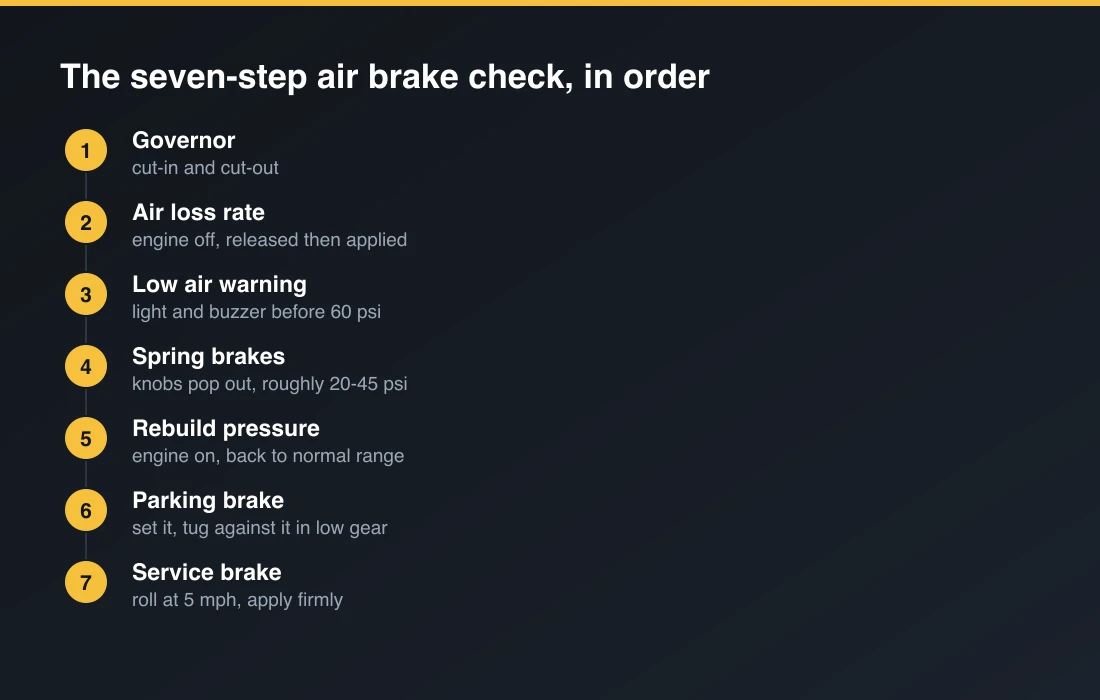
The CDL manual folds air brakes into the standard seven-step pre-trip rather than treating them as a separate routine. Two items move earlier — the air compressor drive belt in the engine compartment, the slack adjusters, drums, linings and hoses on the walk-around — and Step 7, the final brake check, is replaced outright. That replacement is itself seven tests, in this order.
- Governor cut-in and cut-out. Run the engine at a fast idle. The compressor should cut out at about 125 psi, and the gauge stops climbing. Drop back to idle, fan the brake pedal, and it should cut in again at about 100 psi. Both figures are approximate; the manufacturer's spec governs.
- Static leak rate. Fully charged (typically 125 psi), engine off, wheels chocked, parking brake released. Time one minute. The loss must be under 2 psi for a single vehicle, under 3 psi for a combination.
- Applied leak rate. Build back to governor cutout (120–140 psi), shut the engine off, release the parking brake — and the tractor protection valve on a combination — then hold the foot brake fully down for one minute. Loss must be no more than 3 psi single, 4 psi combination.
- Low air warning. Electrical power on, engine off, fan the pedal down. The light, buzzer or wig-wag must come on before pressure drops below 55 psi in the tank with the lowest reading.
- Spring brakes apply on their own. Keep fanning. The parking brake valve — plus the tractor protection valve on a tractor-trailer — should pop out inside the manufacturer's range of 20 to 45 psi.
- Rate of pressure build-up. Start the engine at operating rpm. A dual air system should build from 85 to 100 psi within 45 seconds.
- Parking brake, then service brakes. Set the parking brake and tug gently against it in a low gear. Release it, roll forward at about 5 mph, and apply the pedal firmly. Note any pull to one side, an odd feel, or a delayed stop.
Say them aloud in that sequence while you study. State examiners work from their own score sheets, so the road-test order and the wording can differ — but the numbers behind each check do not.
The numbers worth memorizing
- Cut-out about 125 psi, cut-in about 100 psi.
- 2, 3, 3, 4. Released: 2 psi single, 3 psi combination. Applied: 3 psi single, 4 psi combination. A combination is always allowed one more psi than a single vehicle.
- 55 psi for the low air warning. Older vehicles use one half the governor cutout pressure instead, and large buses commonly signal at 80–85 psi. A manual still printing 60 psi is an older edition: 49 CFR 393.51 sets the warning at 55 psi and below, or half the cutout pressure, whichever is less.
- 20 to 45 psi for spring brake application.
- 85 to 100 psi in 45 seconds on a dual system. Before you move, build at least 100 psi in both the primary and secondary systems.
- Brake lag. Air takes half a second or more to reach the brakes. At 55 mph on dry pavement it adds about 32 feet, and total stopping distance runs over 450 feet.
What actually happens at 20 psi
The question usually reads: as air pressure falls, when do the spring brakes come on? The honest answer is a band, not a single number.
Spring brakes are held off by air pressure. Take the air away and heavy coil springs push the brakes on — that is why they double as your parking and emergency brakes. The valve closes somewhere in the 20 to 45 psi range, so by the time the needle reaches 20 psi they are already applied.
That is not a controlled stop. Spring brakes do not act on every axle, so a heavily loaded vehicle keeps rolling a long way. A light one, or one on a slick road, can skid out of shape when they grab. This is why the low air warning matters: when it lights, park while you still have foot brakes.
When the brakes fade on a downgrade
Fade is a heat problem. Sustained braking cooks the lining, which changes it chemically and cuts its friction, and it expands the drums so the shoes have to travel farther to touch — with less force when they do. Brakes out of adjustment make it worse: the ones still working take the extra load and overheat first. The early symptom is needing more and more application pressure to hold the same speed.
The manual's fix is to keep the brakes out of it. Choose a safe speed for the weight, the length and steepness of the grade, the road and the weather, and get into the proper low gear before you start down — brakes only supplement engine braking. Then:
- Apply firmly enough to feel a definite slowdown.
- Release when you are roughly 5 mph below your safe speed — about a three-second application.
- Reapply once you are back up to your safe speed, and repeat to the bottom.
If your safe speed is 40 mph, you brake at 40, ease off at 35, and do it again.
If the brakes are truly gone, the thing that stops you is outside the truck. An escape ramp is the best outcome; ramps sit a few miles below the crest and are signposted, which is why you read the signs going up. Without one, take the least hazardous route out early — an open field, a side road that flattens or climbs. Waiting only makes the vehicle faster and the choices worse. Once you are down, never set the parking brake on hot brakes; chock the wheels and let them cool.
Failing this test costs you more than the test
The air brake knowledge test is not optional in the way an endorsement is. Fail it, or take your skills test in a vehicle without air brakes, and an L restriction goes on your licence barring you from driving any air-braked commercial vehicle. That rules out most tractor-trailers and a good share of straight trucks. Removing it later means going back and passing both the knowledge test and a skills test in an air-braked vehicle.
Drilling the questions
These numbers are the kind you get right once, forget, and get wrong again a week later. CDL Prep Exam 2026: Permit keeps Air Brakes as its own practice set, with an explanation after each answer and a review pass over the questions you missed, so the leak rates and pop-out ranges get drilled rather than skimmed. Flashcards handle the pure recall, and it works offline for study in the cab.
Quick answers
What is the L restriction?
A note on your licence barring you from operating a commercial vehicle with air brakes. It is applied if you fail the air brake knowledge test or take your skills test in a vehicle without them.
Why does the low air warning come on at 55 psi?
Because it has to warn you well before the spring brakes apply on their own, which happens somewhere in the 20 to 45 psi range. The gap is your time to stop somewhere safe.
Do I need the air brake test for a Class B?
If the vehicle you drive has air brakes, yes. The restriction follows the equipment, not the class.
Which manual section covers it?
Section 5. Read it end to end rather than skimming — the seven-step check is written out there in the order the examiner expects.
What to do next
Read Section 5 of your state's CDL manual end to end — it is free, and it is what your test is written from. Then work the seven checks until you can recite them without the list in front of you, and drill the numbers until 2, 3, 3, 4 and 20 to 45 come back without a pause. Book the test when both come out cold.