The Hazmat endorsement — the letter H on a CDL — is the only endorsement that runs through a federal agency as well as your state licensing office. Two separate things have to clear: a knowledge test at the DMV, and a security threat assessment run by TSA. Either one can stop the endorsement on its own.
Before you can even take the test
Since February 7, 2022, a state may not administer the H endorsement knowledge test to a driver taking it for the first time until that driver has completed entry-level driver training for hazardous materials with a provider listed on FMCSA's Training Provider Registry. It is theory training only — there is no behind-the-wheel portion for H — and your provider files the completion record electronically. Drivers who held the endorsement before that date, or who are renewing or transferring one they already hold, do not repeat the training.
- The security threat assessment is TSA's, under 49 CFR Part 1572. You enroll in person, give fingerprints and pay a fee, and TSA reviews criminal history, immigration status and terrorism watch lists. A determination is valid for five years.
- There is no skills test. H is knowledge only.
- H cannot go on a commercial learner's permit. Federal rules limit CLP endorsements to P, S and N.
- You must be 21 to haul placarded loads in interstate commerce.
- Renewal means testing again. To keep the endorsement at renewal you retake the hazardous materials knowledge test and clear a fresh threat assessment.
Federal rules set the pass mark at 80 percent correct on every CDL knowledge test. The number of questions on your Hazmat test is set by your state, so check yours before you book.
The nine hazard classes
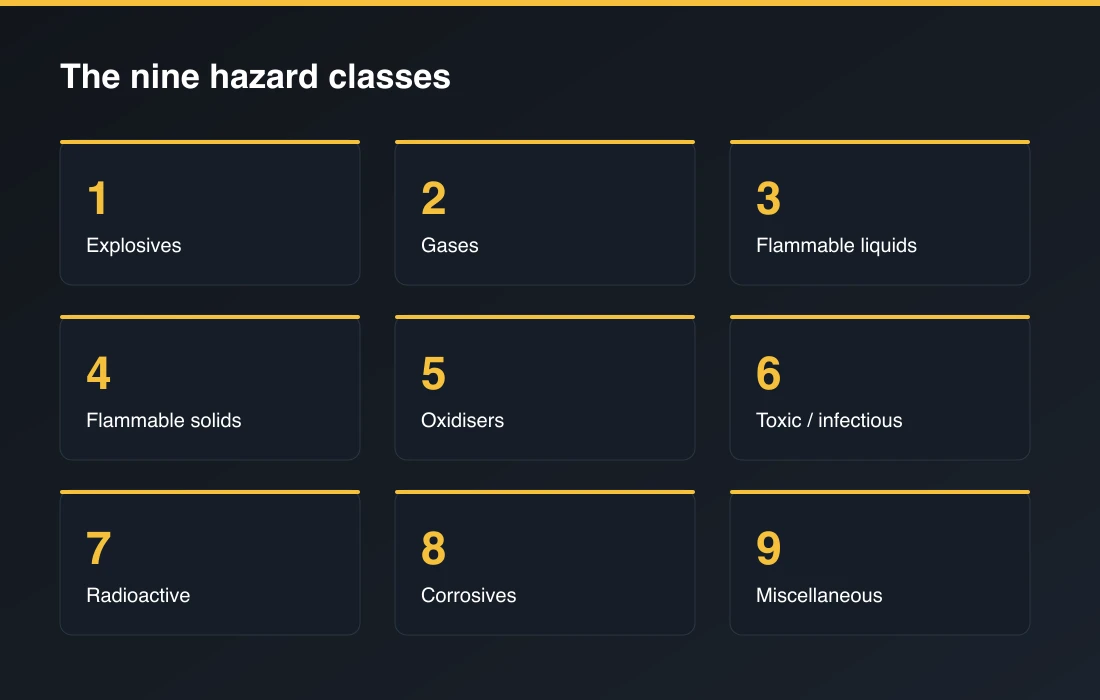
Almost everything else on the test hangs off this list, so learn it cold:
- Class 1 — Explosives, Divisions 1.1 through 1.6.
- Class 2 — Gases: 2.1 flammable gas, 2.2 non-flammable gas, 2.3 poison gas.
- Class 3 — Flammable liquids.
- Class 4 — Flammable solids: 4.1 flammable solid, 4.2 spontaneously combustible, 4.3 dangerous when wet.
- Class 5 — Oxidizers and organic peroxides: 5.1 oxidizer, 5.2 organic peroxide.
- Class 6 — Poisons: 6.1 toxic material, 6.2 infectious substance.
- Class 7 — Radioactive materials.
- Class 8 — Corrosives.
- Class 9 — Miscellaneous hazardous materials.
The question that catches people is "which class is flammable", because the word turns up three times. Class 3 is the flammable liquid — federal rules define it as a liquid with a flash point of not more than 140°F (60°C). Division 2.1 is flammable gas and Division 4.1 is flammable solid. Read the state of matter in the question, not just the word.
Placards and the 1,001-pound line
Placarding is where the test gets specific, and the answer usually comes down to which of two tables the material sits in.
- Table 1 materials need placards in any amount. Table 1 is Divisions 1.1, 1.2 and 1.3 explosives, 2.3 poison gas, 4.3 dangerous when wet, temperature-controlled Type B organic peroxide, materials poisonous by inhalation, and Radioactive Yellow III.
- Table 2 materials need placards at 1,001 pounds. That is the aggregate gross weight of Table 2 material on the vehicle — packaging included, not just product. Everything else lives here: 1.4 through 1.6, flammable and non-flammable gas, flammable liquid, combustible liquid, 4.1, 4.2, oxidizer, other poisons, corrosive and Class 9.
- A placarded vehicle wears four placards, one on each side and one on each end.
- Each placard must be readable from the direction it faces and sit at least three inches clear of any marking that would weaken it.
- The DANGEROUS placard can replace separate placards when two or more Table 2 categories are aboard. Once 2,205 pounds of one category is loaded at a single facility, that category's own placard goes back up.
Placards measure at least 250 mm — 9.84 inches — on a side, turned square-on-point into the familiar diamond.
Shipping papers, and where they have to sit
A hazmat shipping paper describes the load in a fixed order: identification number, proper shipping name, hazard class or division, then packing group. When ordinary freight shares the same paper, the hazmat entries have to stand out — listed first, printed in a contrasting color, or flagged with an X in a column headed HM.
Where the paper sits is itself a test question:
- Behind the wheel, it must be within immediate reach while your seat belt is fastened, and either in plain view to someone opening the driver's door or in a holder mounted inside that door.
- Away from the controls, it goes in that door holder or on the driver's seat.
Emergency response information travels with it and has to be immediately accessible to you. Carrying the current Emergency Response Guidebook satisfies that requirement.
Parking, routes and smoking
These rules cost points because the numbers look alike. Learn which apply to every placarded load and which apply only to Divisions 1.1, 1.2 and 1.3 explosives.
- Any placarded vehicle: do not park within 5 feet of the traveled portion of a road, except briefly when the work genuinely requires it.
- Divisions 1.1, 1.2 and 1.3 only: also never within 300 feet of a bridge, tunnel, dwelling, or a building where people work, congregate or assemble — the same narrow exception applies — and never on private property unless the person in charge knows what you are carrying.
- Attendance: an explosives load must be attended at all times. Attended means on the vehicle, awake and not in the sleeper berth, or within 100 feet of it with the vehicle in unobstructed view. A safe haven — an area approved in writing by a government authority for unattended parking — is the exception.
- Route plan: those explosives move on a written route plan that avoids heavily populated areas, crowds, tunnels, narrow streets and alleys wherever a practicable alternative exists. Keep the plan in the cab.
- Smoking: no smoking or lighted cigarette, cigar or pipe within 25 feet of a vehicle carrying explosives, oxidizers or flammables, or of an empty tank that carried a flammable liquid or gas.
- Fueling: engine off, and someone in control of the process at the fill point.
On top of the federal rules, states and cities set their own tunnel bans and designated hazmat routes. Your state manual lists them, and the test can ask about them.
Start the TSA check before you study
The knowledge test is the part people prepare for and the part that finishes fastest. The security threat assessment is the one with a queue: you enrol in person, give fingerprints, pay a fee, and then wait while TSA reviews the file. That wait is measured in weeks, not days, and no amount of studying moves it. Book the appointment first, then use the waiting time to work through Section 9.
Practicing the questions
The tables are what make Hazmat hard: class against division, placard against quantity. CDL Prep Exam 2026: Permit keeps HazMat as its own practice set with a clear explanation after every answer, flashcards for the class-and-placard pairs, and a review of the questions you keep missing.
Quick answers
Does the Hazmat endorsement expire?
Yes, and it is tied to your security threat assessment rather than to the knowledge test. Renewal means going through the TSA process again, so start it well before the expiry date.
Do I need Hazmat to carry any hazardous material at all?
No. The endorsement is required when the load requires placards, which is where the 1,001-pound line and the specific class rules come in.
Can I take the knowledge test before the TSA check clears?
In most states yes, and the endorsement is not added to your licence until the assessment comes back clear.
Which manual section is it written from?
Section 9 of your state's CDL manual. It is the AAMVA model text with your state's specifics filled in, and it is what the questions are drawn from.
Where to start
Read Section 9 of your own state's CDL manual first. It is the AAMVA model text with your state's specifics filled in, and the test is written from it. Book the TSA appointment early, because the threat assessment takes time and no state can issue the endorsement without a clear determination. Then work practice questions until the class-and-division list comes back without hesitation, and sit the test.