The signs part of the CDL knowledge test looks like a memory game: a wall of pictures to learn by heart. It is not. Every road sign in the United States follows the Manual on Uniform Traffic Control Devices, and that manual hands each shape and each color to one category of message. Learn the system and you can read a sign you have never seen before.
The system does not cover the other half of this topic: the dozen or so signs that mean something routine in a car and something serious in an 80,000-pound combination. Downgrades, low clearance, posted weight limits, escape ramps, truck restrictions and railroad crossings are the ones worth your study time.
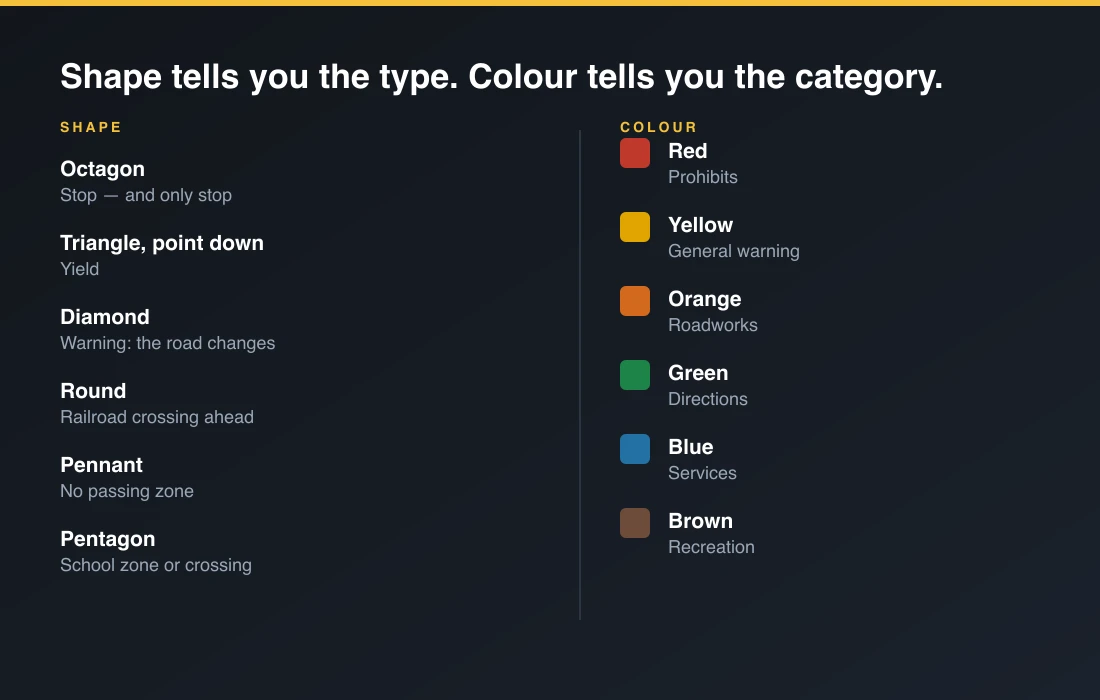
Shape tells you the message before you can read the words
Shape is designed to survive fog, glare, road spray and a sign turned half away from you.
- Octagon — stop. No other sign in the country uses this shape, which is why a stop sign still reads as one when the face is caked in salt.
- Triangle, point down — yield.
- Diamond — warning. Something about the road ahead is about to change.
- Pennant — a horizontal triangle pointing right, mounted on the left side of the road, marking the start of a no-passing zone.
- Pentagon — school advance warning and school crossing.
- Round — the railroad advance warning sign.
- Crossbuck — the X at the crossing itself.
- Vertical rectangle — regulatory, meaning a law you have to obey. Horizontal rectangle — guide: routes, exits, distances.
Color tells you what kind of message it is
- Red — stop or prohibition.
- Yellow — general warning.
- Orange — temporary traffic control: work zones, flaggers, lane shifts.
- Fluorescent yellow-green — pedestrian, bicycle, playground and school warnings, split out from plain yellow.
- Green — guide signs and permitted movements.
- Blue — road user services. Brown — recreational and cultural sites.
- Fluorescent pink — incident management: a crash scene or an unplanned closure ahead.
- Black on white — regulatory.
The signs that carry extra weight in a heavy vehicle
Downgrade warning. A truck-on-a-hill symbol, usually with a plaque giving the percent grade and often the length. Percent grade is simply feet of drop per 100 feet of road, so 6 percent means the road falls six feet every hundred. The MUTCD guidance for posting these includes combinations such as a 5 percent grade running more than 3,000 feet. A TRUCKS USE LOWER GEAR plaque means downshifting, not just braking, is expected. The CDL manual ties safe speed to the total weight of vehicle and cargo, the length and steepness of the grade, road conditions and weather. Where a Maximum Safe Speed is posted, never exceed it. Go slow enough that the brakes hold you back without overheating: hot brakes fade, and you press harder and harder for the same result.
Runaway truck ramp. Advance signs are placed roughly one mile and half a mile ahead of the grade and of the ramp, and a plaque may name the surface: SAND, GRAVEL or PAVED. Ramps use loose, soft material, sometimes with an upgrade, to stop a vehicle that has lost its brakes. Know where the ramps are on your route before you start down.
Low clearance. These go up where the vertical clearance is under 14 feet 6 inches, or less than 12 inches above the statutory maximum vehicle height in that state, whichever of the two is greater. The manual adds two cautions: do not assume posted heights are correct, since repaving or packed snow can steal inches, and an empty van sits higher than a loaded one.
Weight limit. A posted limit on a bridge or road is regulatory, black on white, and set by the road authority. Federal limits on the Interstate System are 80,000 pounds gross, 20,000 on a single axle and 34,000 on a tandem, but where a bridge or road is posted lower, the posted number is the one that governs.
Truck restrictions. A truck symbol inside a red circle and slash means no trucks. Truck route and hazardous material route signs point you to the roads you may use, and an HM sign with a slash through it bars placarded loads.
Advisory speed. The yellow plaque under a curve or ramp warning is set for passenger cars. FMCSA rollover guidance is blunt: a loaded trailer with a high center of gravity has to go slower than the number on the plaque.
Railroad crossings and the rule behind the signs
- The round, black-on-yellow advance warning sign sits ahead of a public crossing and means slow down, look and listen for a train, and be ready to stop.
- Pavement markings carry the same message as that sign, along with a no-passing marking on two-lane roads.
- The crossbuck marks the crossing itself and requires you to yield the right of way to the train. A plaque underneath gives the number of tracks.
Under 49 CFR 392.10 a full stop is federally required for buses carrying passengers, vehicles hauling any quantity of chlorine, placarded vehicles, and cargo tanks used for hazardous materials whether loaded or empty. The stop is within 50 feet of the tracks and no closer than 15 feet. The exceptions the rule lists are a crossing marked Exempt, an abandoned crossing signed as abandoned, a functioning green traffic signal, a police officer or flagman directing you across, and streetcar or industrial switching tracks inside a business district.
Two more points from the manual. Do not shift gears while you are on the tracks, and give yourself room: a typical tractor-trailer needs at least 14 seconds to clear a single track and more than 15 to clear a double. Low-slung equipment such as lowboys, car carriers, moving vans and possum-belly livestock trailers can hang up on a raised crossing, which is what the low ground clearance sign warns about.
How signs show up on the knowledge test
Questions rarely stop at naming a sign; they ask what you should do about it, which is why the downgrade, clearance and crossing signs above pull more than their share. Federal rules require at least 80 percent correct to pass a knowledge test, though the number of questions and how the signs material is split among tests are set by your state.
Practicing in mixed sets is what makes the shape-and-color system automatic. CDL Prep Exam 2026: Permit runs signs questions inside General Knowledge with an explanation after each answer, plus flashcards and a review pass over the ones you miss.
What to do next
- Read the signs pages of your own state's CDL manual, since state manuals adapt the model manual and your test comes from yours.
- Say the category out loud on your next drive: shape, color, then meaning.
- Drill mixed question sets rather than studying signs one category at a time, because the test does not group them either.
- Keep a list of the ones you miss twice and re-read the manual paragraph behind each, not just the answer key.