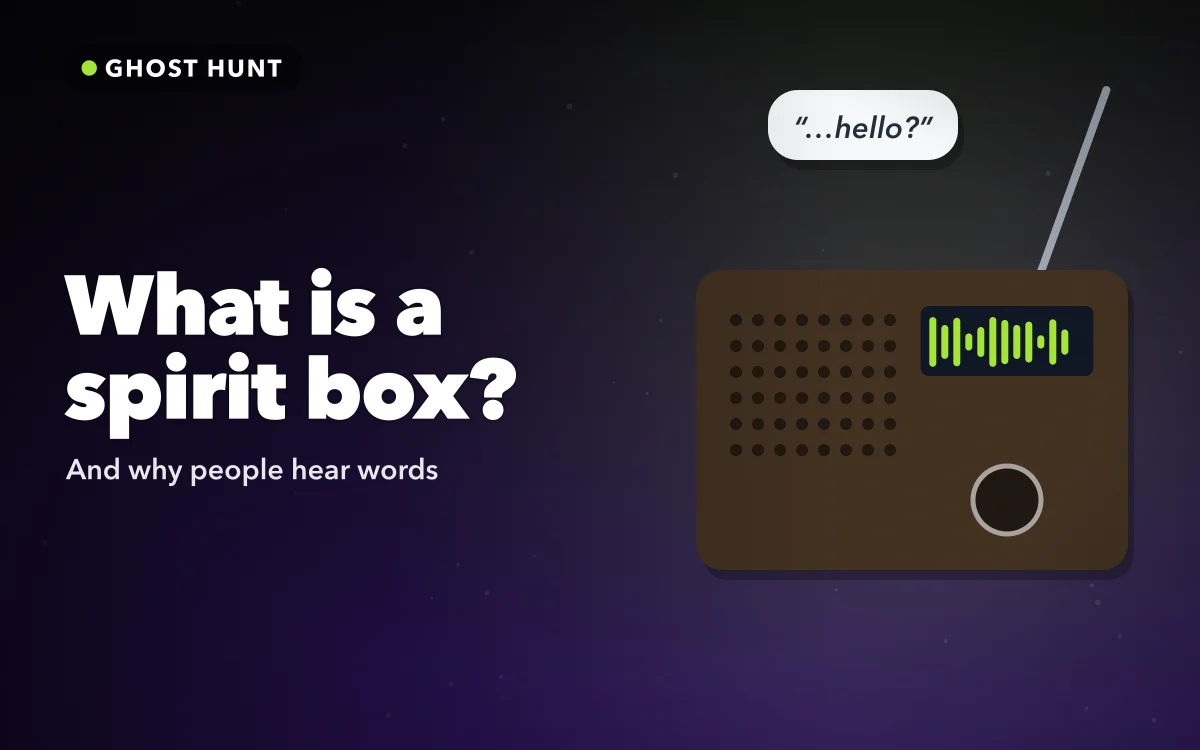
If you have watched a ghost-hunting show or played Phasmophobia, you have seen the scene: someone holds up a small radio hissing with static, asks a question into the dark, and a word seems to come back.
That radio is a spirit box. The device itself is simple to explain; the voices are what make it interesting, and they say more about how hearing works than about anything in the room.
What is a spirit box? The short version
A spirit box is an AM/FM radio, either a modified receiver or one built for the job, that never settles on a station. Instead of tuning in, it sweeps through the band, landing on each frequency only briefly. What comes out is static broken by tiny fragments of whatever was broadcasting at that moment: a syllable of a news bulletin, half a word from a phone-in.
People ask questions aloud and listen for those fragments to form replies. No controlled study has shown that a spirit box communicates with anyone. The words are well explained by how the brain handles speech in noise, and by the question just asked. It is entertainment, and that is the honest way to treat it.
How the radio sweep works
An ordinary radio locks onto one frequency and stays there. A spirit box sweeps from one end of the band to the other, again and again.
It rarely catches more than a scrap of any broadcast, and between stations it picks up hiss. The result is a choppy rhythm: dead air, static, a clipped consonant, a vowel, static again. Those scraps are often genuine words from a real broadcast, cut loose from their sentence.
Two things shape what you hear:
- Sweep speed. A faster sweep gives shorter fragments, closer to single syllables. A slower one lets whole words through, which makes an ordinary broadcast word easier to mistake for a reply.
- Where you are. The fragments come from whatever stations reach the radio, so the same device sounds different in a city than in a remote cottage, and AM can sound different again at night.
Follow along in Ghost Hunt: Spirit Box & EMF
Free on the App Store for iPhone and iPad.
App Store
Where the idea came from
The spirit box grew out of an older claim known as EVP, or electronic voice phenomena: the idea that voices appear on audio recordings, unheard at the time and noticed only on playback. EVP is associated with Friedrich Jürgenson and Konstantīns Raudive in the mid-20th century.
The radio-sweep device is most associated with Frank Sumption, whose first versions, built in the early 2000s, became known as Frank's Box. Its appeal over EVP was immediacy: you ask a question and hear something straight away, which is exactly what makes it persuasive in the moment.
Spirit box, ghost box, Frank's Box: one idea, several names
Many people expect a spirit box and a ghost box to be different devices. In practice the names are used interchangeably.
- Spirit box is the name you will see in shops, on television and in games.
- Ghost box means the same device, and enthusiasts use both names.
- Frank's Box refers to the original devices associated with Frank Sumption.
Where a seller draws a line between them, it is branding, not a technical difference.
Why your brain finds words in the noise
Your brain is not a passive microphone. It constantly predicts what it is about to hear and fills in gaps, which is how you follow a conversation in a loud restaurant.
Psychologists call the tendency to perceive a familiar pattern, such as a face or a voice, in vague or random input pareidolia; it is why you see faces in clouds. Auditory pareidolia is the same thing for sound: hearing words or voices in noise that contains none, or only fragments.
A spirit box is close to an ideal trigger. It supplies what the speech system latches onto, clipped consonants and vowel-like tones, but never enough to settle what was said. The brain resolves the ambiguity with its best guess, and the guess feels like hearing rather than guessing.
Two things make it stronger during a ghost hunt:
- The question primes the answer. Ask "What is your name?" and the next fragment gets heard as a name. Ask "Are you here?" and a clipped syllable becomes "yes".
- Different listeners hear different words. Each guess draws on that person's expectations, so the same clip is heard differently around the room. Once someone says a word aloud, others often start hearing it too, the way on-screen lyrics change a mumbled song.
None of this means anybody is lying. People who report hearing a name are usually describing exactly what they perceived; it is the source that gets misread.
Try a blind listen
When someone hears a clear word, have everyone write down what they heard before anyone speaks, then compare. Replay clips without saying what you think they say. The answers often differ until someone suggests a word, and then the room starts to agree.
Real devices, game versions and apps
Three different things now share the name.
Hardware spirit boxes are genuine radios, modified or purpose-built, and the fragments are real broadcast audio chopped up by the sweep.
The game version is fiction. In Phasmophobia, a horror game by Kinetic Games, the spirit box uses voice recognition to pick up the questions players speak, and the in-game ghost answers by the game's rules. Real devices do nothing of the kind: a radio cannot understand a question.
iPhone apps cannot scan real stations, because iOS gives apps no access to a radio tuner. An iPhone app usually makes the sound itself, either by generating it or by playing it from a built-in sound bank, which is fine when it says so. Our own app, Ghost Hunt, generates every sound and labels each word "Generated word"; it has no microphone, so any fitting reply is the effect above in action. Do spirit box apps work has the iPhone detail, and ghost-hunting equipment explained covers the rest of the kit.
Quick answers
Is a spirit box the same as a ghost box?
Yes. The names are used interchangeably, and Frank's Box is the early version associated with Frank Sumption.
Can a spirit box really talk to ghosts?
There is no controlled evidence that it can; the replies are well explained by auditory pareidolia and by the question just asked. Many people still find their sessions meaningful.
Why does everyone in the room hear a different word?
Each brain fills the gaps with its own guess, and once someone says a word aloud, the others tend to hear it too.
Is the spirit box in Phasmophobia like a real one?
Only in how it looks and sounds. The game's version listens to your questions; a real spirit box cannot understand a question and only sweeps the band.
Where to get it
If you want the experience for a game night rather than a real radio, Ghost Hunt: Spirit Box & EMF generates its FM/AM-style sweep, static and words inside the app, with controls for sweep speed, direction, noise level and how often words appear. It needs no camera or account, and it is free with ads. Running it as a party game works best with the lights down and a pen for every player.
It is entertainment, and it is at its best when everyone in the room knows that.