A gym is not just loud, it is loud in a specific way. Air conditioning and treadmills produce a broad low rumble, weights produce sharp impacts, and the room's own music sits right on top of everything you are trying to hear.
The instinct is to turn your music up until it wins. That works, briefly, and it is the reason a lot of people have worse hearing than they should. Shaping the sound is the better answer, and it is usually enough.
Why raising the volume fails
Background noise does not mask all frequencies equally. Low rumble masks your bass, and a busy room masks the midrange where vocals and melody live.
When you raise the overall volume you lift everything, including the bass that was already competing with the rumble. The result is more energy in your ears without much more clarity — which is why the music seems to need another notch two minutes later.
Lifting only the parts that are being masked gets you the clarity at a much lower level.
A gym starting point
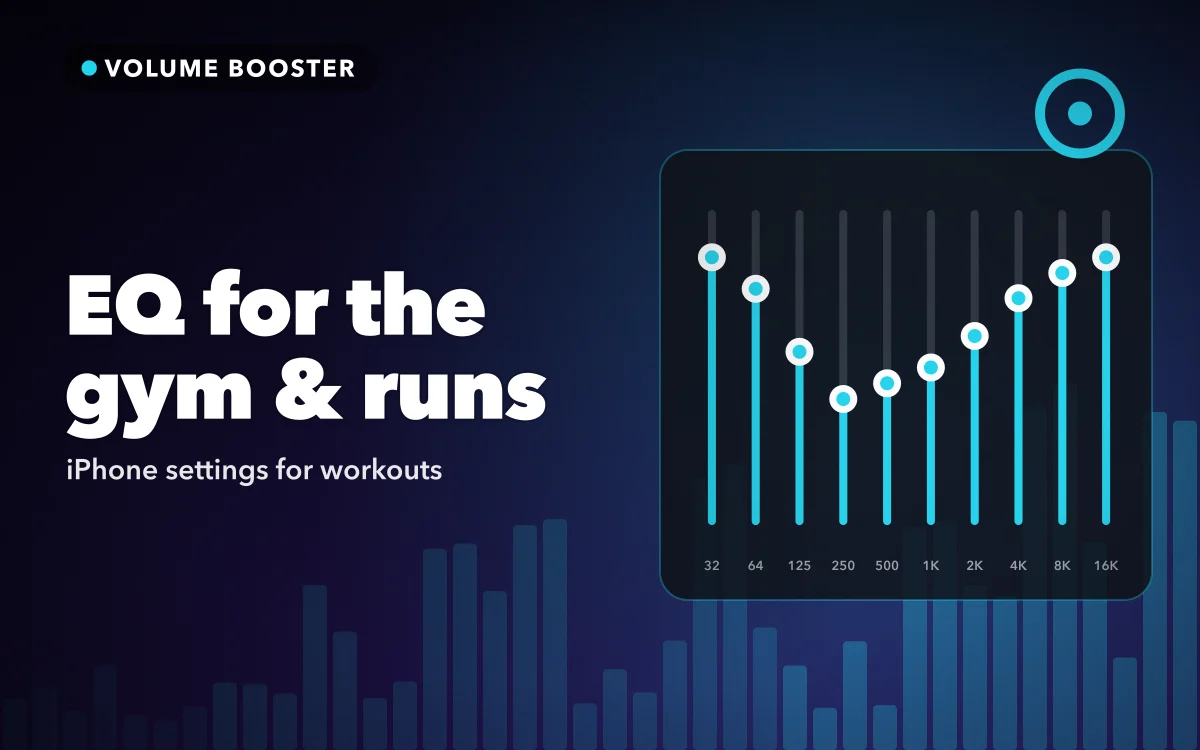
Assuming a ten-band equaliser, this is a sensible place to begin. Adjust rather than copy exactly, because headphones vary enormously.
- 32 Hz — leave flat or cut slightly. The room already has more low rumble than you need, and this band mostly adds mush in a noisy space.
- 64 Hz — small lift. Keeps the drive without muddying anything.
- 125 Hz — flat.
- 250 Hz — cut. In a reverberant room this is where everything piles up.
- 500 Hz — flat.
- 1 kHz — small lift. Brings the core of the vocal forward.
- 2 kHz — lift. This is the band that makes a voice cut through noise.
- 4 kHz — small lift. Adds the attack of drums, which is what you are actually training to.
- 8 kHz — small lift, no more. Too much here becomes fatiguing quickly.
- 16 kHz — flat.
The shape is: cut the mud, lift the presence. It sounds thinner in a silent room and much clearer in a loud one, which is the trade you want.
Follow along in Volume Booster: Bass & EQ
Free on the App Store for iPhone and iPad.
App Store
Running outdoors is a different problem
Traffic noise is lower in frequency than gym noise and much more variable, and there is a safety dimension that a gym does not have.
Two changes from the gym curve. Cut a little more at 64 Hz, because road noise sits low and boosting bass against it is a losing battle. And be more conservative at 8 kHz, because wind noise across an earbud already adds harshness up there.
More importantly: keep one ear on the world. Transparency or awareness modes exist for this, and they work better than simply listening quietly, because you keep the music intelligible while still hearing a car.
Noise is the reason people damage their hearing at the gym
The louder the room, the louder people set their music, and a gym easily reaches a level where a comfortable listening volume is already high. Sustained exposure above roughly 85 dB causes permanent, cumulative damage. Better isolation is the honest fix — sealed in-ears or noise cancelling let you listen much quieter for the same clarity. Check the Headphone Audio Levels chart in the Health app after a few sessions; the number is usually higher than people expect. The safe listening guide has the detail.
Isolation does more than EQ ever will
This is worth saying plainly: the single biggest improvement available is not a setting.
Open earbuds in a loud gym force you to compete with the room. Sealed in-ear tips or active noise cancelling remove the competition, and most people find they drop their volume noticeably without losing anything.
EQ then does its job on a much easier problem.
Music type still matters
The gym curve above is aimed at vocal-led and beat-led music, which is most of what gets played.
For electronic and drum-heavy tracks, ease off the 2 kHz lift slightly and let the 4 kHz do the work, since the attack matters more than vocal intelligibility. EQ settings for EDM has a fuller version.
For podcasts and audiobooks while training, go further in the same direction: more at 2 kHz, less bass entirely. Podcast and audiobook settings covers it.
If you want the bass-heavy feel without the mud, the bass guide explains which band actually produces it.
Quick answers
Should I use a bass boost at the gym?
A small one at 64 Hz, yes. A large one is counterproductive, because gym noise is already concentrated low down and you end up fighting it.
Why does my music sound worse at the gym than at home?
It is not the music. The room is masking the midrange, so the parts that carry melody and vocals are the first things you lose.
Is a volume boost a bad idea in a loud room?
It is where boosting is most tempting and most risky. Use EQ and better isolation first, and treat gain as the last step rather than the first.
What about calls while running?
Different problem — that is about the microphone as much as playback. Making video calls louder covers it.
Where to get it
Volume Booster: Bass & EQ has a ten-band equaliser with saveable presets, so a gym curve and a home curve can be one tap apart.
Cut the mud, lift the presence, and fix the earbuds before you touch the volume.