Every argument about CDL classes comes down to two numbers: 26,001 pounds and 10,000 pounds. Federal rule 49 CFR 383.91 sorts commercial vehicles into Group A, Group B and Group C using those two figures — not the make of the truck, not the length of the trailer, not what you haul.
Get the numbers straight and most of the question answers itself.
The two numbers that decide your class
- 26,001 pounds is the weight line. At or above it, a vehicle is in the CDL program because of its size alone. Below it, a vehicle needs a CDL only because of what it carries.
- 10,000 pounds is the trailer line. It applies to the rating of whatever you are towing, and it is what separates a combination license from a straight-truck one.
Both are ratings, not scale readings. FMCSA defines GVWR as the value the manufacturer specifies as the loaded weight of a single vehicle, and GCWR as the manufacturer's combination rating or the sum of the ratings of the power unit and towed units, whichever produces the higher value (49 CFR 383.5). An empty trailer plated at 14,000 pounds still counts as a 14,000-pound trailer.
What each class lets you drive
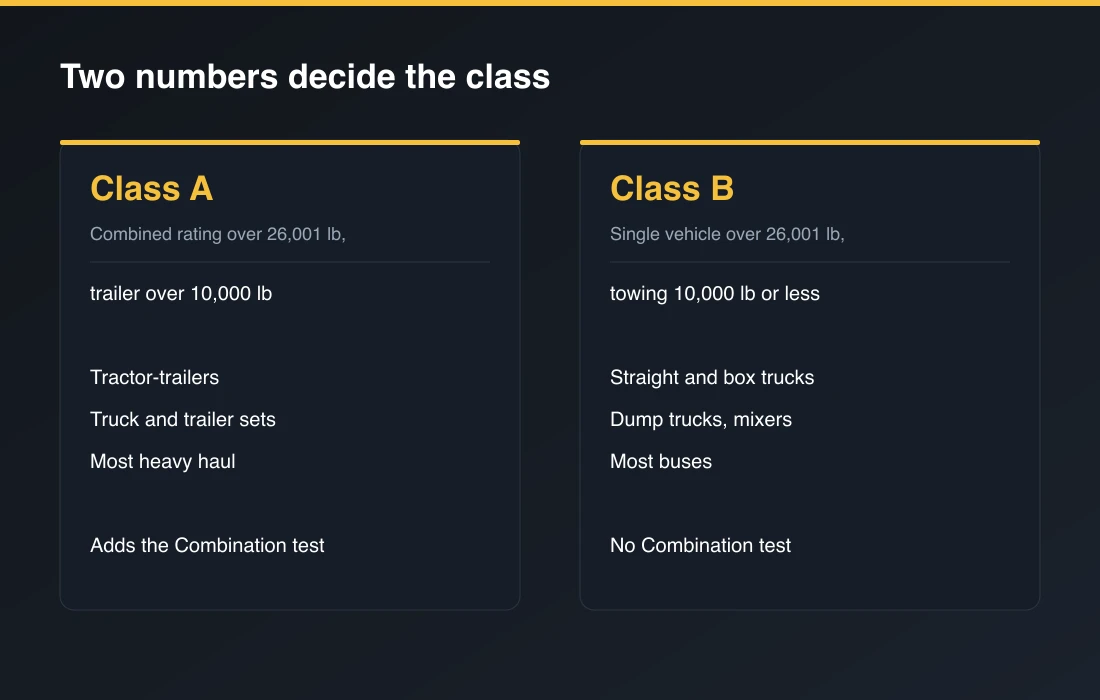
- Class A, combination vehicles. Any combination with a gross combination weight rating of 26,001 pounds or more, provided the vehicle or vehicles being towed are rated over 10,000 pounds. Tractor-semitrailer rigs and truck-and-trailer combinations — the flatbed and reefer work most people picture when they hear trucking.
- Class B, heavy straight vehicles. Any single vehicle rated 26,001 pounds or more, or such a vehicle towing something rated 10,000 pounds or less. Dump trucks, box trucks, garbage trucks, mixers, transit buses and most school buses.
- Class C, small vehicles. Anything that meets neither definition above but is designed to carry 16 or more passengers including the driver, or is used to haul hazardous materials in amounts requiring placards under 49 CFR part 172 subpart F, or a select agent listed in 42 CFR part 73.
The classes stack downward. A Class A holder may also drive Class B and Class C vehicles, and a Class B holder may drive Class C vehicles, in both cases with whatever endorsements those vehicles require. Moving the other way, from B up to A, means testing again.
Ratings, not what is on the scale today
Borderline vehicles are where people guess wrong, and they are where exam questions live.
- A one-ton pickup rated 14,000 pounds pulling a gooseneck rated 18,000 pounds is a 32,000-pound combination with a towed unit over 10,000 — Class A, even running empty.
- A 33,000-pound dump truck towing a 9,900-pound equipment trailer stays Class B, because the trailer's rating sits under the line.
- A 24,000-pound straight truck pulling a 12,000-pound trailer is Class A. The combination clears 26,001 and the trailer clears 10,000, even though neither unit would need a CDL on its own.
For scale, a normal tractor-trailer runs up to 80,000 pounds gross on the Interstate System (23 U.S.C. 127), three times the class line. That is a highway weight limit, not a licensing threshold. Classification turns on the vehicles sitting either side of 26,001 and 10,000.
Which endorsements attach to which class
- T, doubles and triples. Class A. Two or three trailers behind a tractor is a Group A combination, and the AAMVA manual describes the endorsement as one added to the licenses of Class A drivers. Knowledge test only.
- N, tank vehicle. Class A, B or C, though it applies to a Class C vehicle only when that vehicle is hauling hazardous materials. Knowledge test.
- P, passenger. Any class. Knowledge test plus a skills test in a passenger vehicle. Test in a smaller bus and you take a restriction: M bars Class A passenger vehicles, N bars Class A and B passenger vehicles.
- S, school bus. Any class. Knowledge test plus a skills test in a school bus.
- H, hazardous materials. Any class. Knowledge test plus fingerprints and a Transportation Security Administration threat assessment.
- X. The combined tank and hazmat endorsement, for placarded loads in a tank.
Air brakes are not an endorsement but a restriction, and it applies to every class. Skip or fail the air brake portion of the knowledge test, or take your skills test in a vehicle without air brakes, and the state must add an L restriction barring you from air-brake commercial vehicles. Test on air-over-hydraulic brakes and you get Z instead. Test on an automatic and you get E, which bars manual transmissions.
The parts your state sets
Federal rules set the floor. States fill in the rest, so check your own DMV before you assume.
- Age. Interstate driving requires 21 under 49 CFR 391.11. States generally issue a CDL at 18 for intrastate work, marked with a K intrastate-only restriction, but the specifics differ.
- Pass mark and test length. Federal rule requires at least 80 percent correct on each knowledge test (49 CFR 383.135). How many questions each test carries is set by your state.
- The permit clock. You cannot take the skills test in the first 14 days after your commercial learner's permit is issued, and the permit stays valid for up to a year before knowledge tests have to be retaken (49 CFR 383.25).
- Training. Since February 7, 2022, a first Class A or Class B, an upgrade from B to A, and a first S, P or H endorsement all require entry-level driver training from a provider on FMCSA's Training Provider Registry (49 CFR part 380 subpart F).
- Waivers and extras. Farm, firefighter and military exemptions, and any vehicles a state adds beyond the federal definitions, are state business.
Rated weight, not loaded weight
The single most common misunderstanding about CDL classes is thinking the numbers describe what the vehicle weighs today. They do not. GVWR and GCWR are the manufacturer's ratings, stamped on the door jamb sticker and the trailer plate, and they apply whether the truck is loaded or empty. An empty trailer rated at 12,000 pounds still puts you over the 10,000-pound line. Go and read the two stickers before you decide which test to book.
Studying for the class you picked
Once you know which class you are going for, you can stop studying the rest. CDL Prep Exam 2026: Permit lets you choose your CDL class and the endorsements you want, so the practice sets match the license you are actually taking, with a clear explanation after every answer.
Quick answers
Can I drive a Class B vehicle with a Class A licence?
Yes. Class A is the broader licence and covers Class B and Class C vehicles, provided you hold any endorsements those specific vehicles require.
What if I only ever tow a small trailer?
Then Class B is likely enough, as long as the trailer's rating stays at 10,000 pounds or below. Check the plate rather than guessing from its size.
Does the Combination test apply to Class B?
No. The Combination Vehicles test attaches to Class A, because it covers coupling, uncoupling and the handling of a tractor-trailer.
Can I upgrade later?
Yes, and it means taking the additional knowledge tests and a skills test in a representative vehicle. Starting with the class you will actually drive is usually cheaper than upgrading.
What to do next
- Write down the vehicle you will actually drive, with its GVWR from the door jamb sticker and the trailer's GVWR from the trailer's own plate.
- Do the arithmetic once. Combination over 26,001 with a trailer over 10,000 means Class A; a single unit over 26,001 means Class B.
- Add the endorsements the job needs, and check whether the vehicle you will test in has air brakes.
- Read your state's CDL page for age, permit and training rules before you pay a test fee.
- Study the modules for that class, not all nine.