Watch a few episodes of a paranormal show and you will hear EMF, EVP, baseline, K2 and cold spot within minutes. If you are planning your own investigation, knowing these ghost hunting terms helps you follow along and makes your hunt feel more like the real thing.
This glossary explains what each term means, and, where it is a tool, what it actually measures. Some describe real measurements. Some describe experiences people report. Knowing which is which keeps your investigation fun and honest.
Measurement terms
EMF
Short for electromagnetic field. In ghost hunting, EMF usually means readings from a meter that detects changes in electric or magnetic fields.
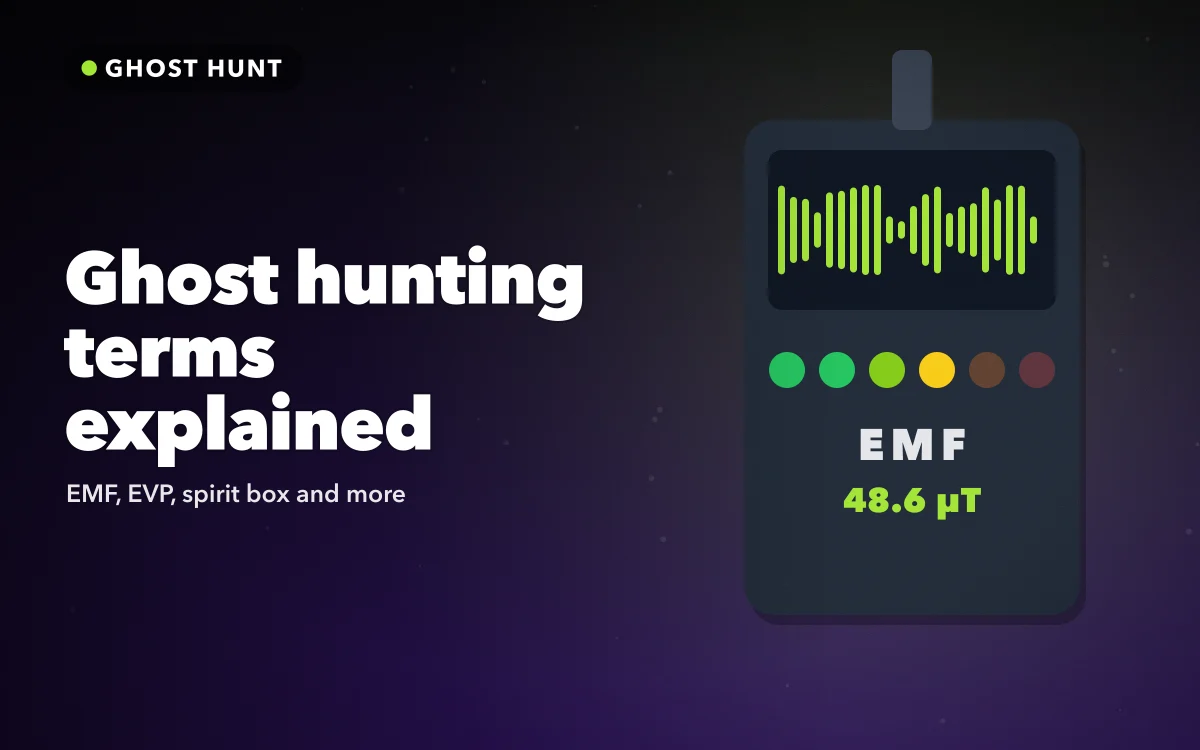
A phone EMF app, like the one in Ghost Hunt, reads the iPhone's magnetometer and shows magnetic field changes in microtesla (µT). That is a real measurement. Changes come from magnets, metal, electronics and moving the phone.
Microtesla (µT)
The unit of magnetic field strength used by phone EMF meters. The Earth's field is roughly 25 to 65 µT at the surface, which is what a calm room reads on an iPhone.
Baseline
The normal reading in a space before an investigation starts. Ghost hunters take a baseline so they can tell when something changes. In Ghost Hunt, one-tap calibration sets your room's baseline, and the meter shows the change from it.
K2 meter
A popular handheld EMF meter with a row of coloured LEDs that light up as the reading rises. Ghost Hunt's five-level LED bar works in a similar way, using the phone's magnetometer.
Spirit Box and audio terms
Spirit Box
A device or app that sweeps through radio frequencies, producing bursts of static and fragments of sound. Ghost hunters listen for words in the noise.
Ghost Hunt's Spirit Box is different: it is generated. The static, sweep and words are all created by the app at random, for fun. Nothing is picked up from the air, and every word is labelled "Generated word" on screen.
Real and generated, kept apart
In Ghost Hunt, real magnetic spikes from the EMF meter and generated words from the Spirit Box are logged separately during an investigation. You can always see which events came from a sensor and which came from the game.
Sweep rate
How fast a Spirit Box moves through its frequencies. Faster sweeps produce shorter fragments. Ghost Hunt lets you control sweep speed, direction, noise level and how often words appear.
EVP
Short for electronic voice phenomena. It describes voices or words that people say they hear in audio recordings that were not audible at the time. EVP sessions usually involve asking questions with a recorder running and listening back later.
Ghost Hunt does not record audio and does not use the microphone, so it does not do EVP recording.
Follow along in Download Ghost Hunt on the App Store
Free on the App Store for iPhone and iPad.
App Store
Reported experiences
Cold spot
An area of a room that feels noticeably colder than its surroundings. Cold spots are usually explained by draughts, windows, poor insulation or air movement from vents.
Residual and intelligent hauntings
Terms used on paranormal shows to describe two kinds of supposed activity: one that repeats like a recording, and one that seems to respond. These are ideas from paranormal storytelling, not measurements.
Orbs
Bright circles that appear in photos. In nearly every case they are dust, pollen, insects or water droplets lit by a camera flash close to the lens.
Matrixing or pareidolia
The tendency of the brain to see faces and patterns, or hear words, in random information. It is why people see faces in clouds and hear words in static. It is also one reason a generated Spirit Box is so much fun: your brain does a lot of the work.
Investigation terms
Investigation or session
One ghost hunt from start to finish. In Ghost Hunt, you can name your investigation, optionally tag your city or area, and end the session to get a shareable report card.
Debunking
Looking for the ordinary explanation behind an event. A good investigator debunks first. When the EMF meter spikes, check for a MagSafe case, magnets or electronics before getting excited.
Trigger object
An object placed in a room to see whether it moves or a reading changes nearby. Often a ball, a toy or a coin. It is a fun addition to a home investigation, especially if someone is assigned to watch it.
Using the terms in your own hunt
You do not need to use every term to have a good night. Pick the handful that suit your plan. Take a baseline in each room, keep a log of the session, assign someone to debunk, and place a trigger object where the group can watch it. Use the Spirit Box as a game and the EMF meter as a real sensor with ordinary explanations.
Speaking the language of the shows adds atmosphere, and knowing what each word really means keeps the evening honest. Everyone can enjoy the scares while knowing exactly what the tools are doing.
Quick answers
What does EMF mean in ghost hunting?
It stands for electromagnetic field. Phone EMF meters measure magnetic field changes using the iPhone's magnetometer.
What is the difference between a Spirit Box and EVP?
A Spirit Box produces sound in real time; EVP describes voices people hear later in recordings. Ghost Hunt's Spirit Box is generated and it does not record audio.
Do ghost hunting tools detect ghosts?
No. EMF meters measure magnetic fields, and Ghost Hunt's Spirit Box generates its words at random for entertainment.
Where to get it
Ghost Hunt puts a real magnetometer EMF meter with baseline calibration and a generated Spirit Box on your iPhone, with investigation logs that keep the two apart. Download Ghost Hunt on the App Store for iPhone.
Learn the words, set your baseline and start your first session.