Cats sleep a lot, and it is easy to assume they do not need much play. Indoor cats in particular can end up with long days and very little to hunt. So how long should you play with your cat, and how often?
There is no single number that suits every cat. But a pattern works for most of them: short, focused sessions, a few times a day, each ending with something the cat can catch.
Why short sessions suit cats
In the wild, cats hunt in short bursts. A stalk, a chase, a pounce, and then a rest. They are not built for long, steady exercise like a dog on a walk.
Play that copies this rhythm tends to work best. A few minutes of intense chasing, a catch, and then a chance to wind down. Many cats lose interest after five to fifteen minutes anyway, and pushing past that point rarely helps.
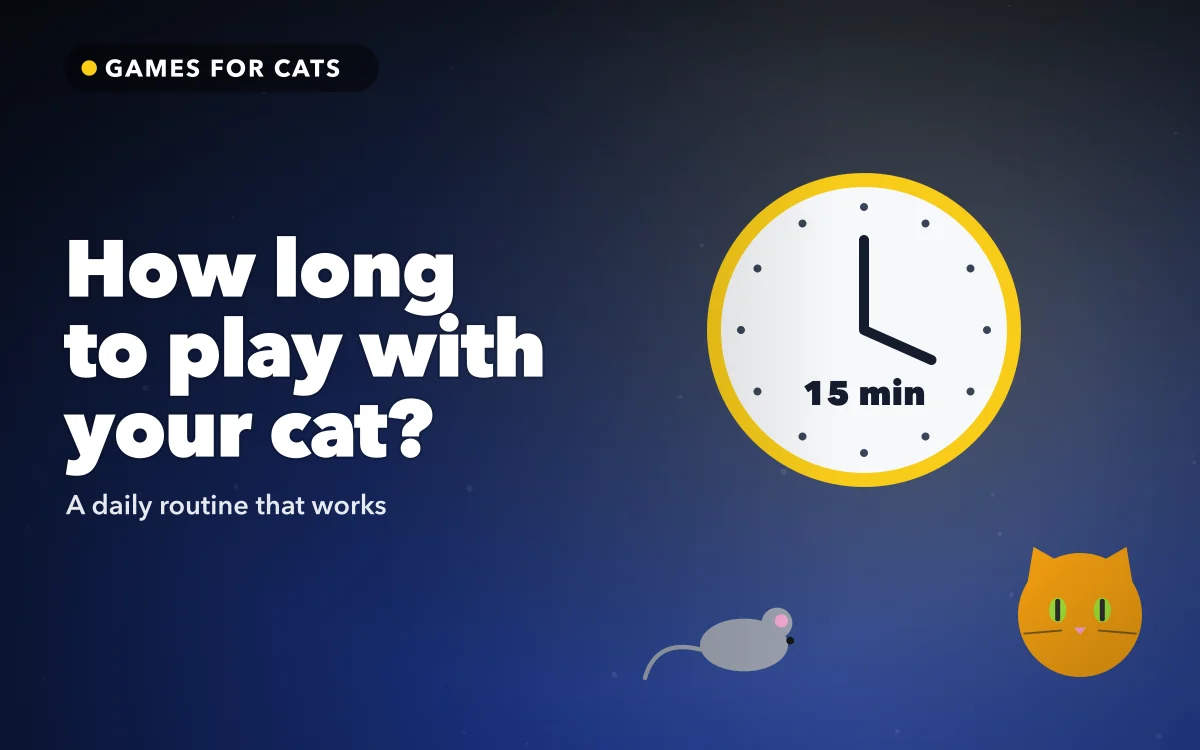
Common advice is two or three sessions a day of roughly ten to fifteen minutes each, but treat that as a starting point. Some cats are happy with less; young, energetic cats may want more.
Reading your cat rather than the clock
The best guide is the cat in front of you.
Signs to keep going: dilated pupils, a low crouch, a twitching tail, quick pounces.
Signs to wind down: panting, lying down mid-chase, watching without moving, walking away.
Panting in particular is a signal to stop. Cats do not pant during normal play the way dogs do, so if your cat is breathing with an open mouth, end the session and let them rest. If it happens often, mention it to your vet.
Follow along in Download Games for Cats on the App Store
Free on the App Store for iPhone and iPad.
App Store
Timing play around meals
A natural cat routine is hunt, catch, eat, groom, sleep. You can copy that at home by playing just before a meal.
A short session before breakfast and another before dinner gives the hunt a satisfying end: the cat chases, catches, and then gets food. Many owners find their cat settles better in the evening with this pattern, and it can help with cats who wake you up early demanding attention.
The hunt, catch, eat pattern
Try a ten-minute play session right before each meal. The chase uses energy, the final catch with a real toy completes the hunt, and the meal afterwards lets your cat wind down naturally into grooming and rest.
Where screen games fit
Screen games are useful in a few specific situations.
When you are busy. You can lay a tablet on the floor and sit nearby while the cat plays, which is easier than waving a wand for ten minutes while you cook.
For variety. A mouse that hides in holes, fish under lily pads and an erratic laser dot give the cat different kinds of prey to think about.
For cats who lose interest in toys. Some cats stop responding to familiar toys. New movement and sound on a screen can bring their interest back.
What screen games cannot do is give the cat something to hold. That is why Games for Cats ends sessions with a calm screen and a reminder to finish with a real toy. The app offers 5, 10 or 15 minute timers, which makes it easy to keep sessions short.
A sample daily routine
This is one example, not a prescription.
- Morning, before breakfast: five to ten minutes with a wand toy or screen game, ending in a real catch.
- Midday, if someone is home: a short session with a ball or a puzzle feeder.
- Evening, before dinner: ten to fifteen minutes of active play, ending in a real catch, then food.
On weekends, when you are home more, you can add an extra short session in the afternoon. Puzzle feeders and treat balls count as play too. They make the cat work for food, which uses the same hunting instinct in a slower way.
Playing with more than one cat
In a home with two or more cats, one often dominates play while the other hangs back. Separate sessions help: one cat with the tablet in one room, the other with a wand toy in another, then swap. Shy cats may only join in when the confident one is busy elsewhere.
If the cats play together happily, take turns rewarding each one with a real catch at the end so neither finishes the session empty-handed.
When to talk to a vet
If your cat suddenly loses all interest in play, seems stiff or sore, or gets breathless quickly, it is worth a check-up. Changes in play can be an early sign that something is wrong. A vet can also advise on how much activity suits an older cat or one with a health condition.
Quick answers
How many minutes a day should I play with my cat?
Many cats do well with two or three short sessions of around ten to fifteen minutes. Watch your cat and stop when they lose interest or start panting.
Is it better to play before or after meals?
Before. Playing before a meal copies the natural hunt, catch, eat pattern and helps many cats settle afterwards.
Can a screen game replace playing with my cat?
Not fully. Screen games are useful for variety and busy moments, but a real toy that the cat can catch should end every session.
Where to get it
Games for Cats gives you short timed sessions with a mouse, a fish pond and a laser dot, plus a reminder to finish with a real toy. Download Games for Cats on the App Store for iPad and iPhone.
A few short hunts a day, each with a real catch at the end, is a routine most cats will happily keep.